TL;DR
A 2026 BCG study of 1,488 workers found that managing multiple AI tools causes acute mental fatigue — not productivity. The science-backed antidote? Writing your own thoughts before outsourcing them to machines.
You toggled between four AI tools before lunch. By 2 PM, you couldn’t remember which draft was yours and which was the machine’s. The fog crept in — not sleepiness, something sharper. A buzzing behind your eyes. AI cognitive atrophy is what researchers now call it, and if you’ve felt your own thinking getting shallower while your AI toolkit gets deeper, you’re not imagining things.
A wave of 2025–2026 research confirms what millions of knowledge workers already suspect: the more you let AI do your thinking, the worse you get at thinking for yourself. But the fix isn’t abandoning AI. It’s a 15-minute habit backed by four decades of neuroscience.
In Brief
AI cognitive atrophy is the measurable decline in critical thinking, memory, and independent problem-solving caused by over-reliance on AI tools. A 2026 Boston Consulting Group study found that workers managing four or more AI tools experienced acute mental fatigue and a 39% increase in major errors. Neuroscience confirms that writing your own thoughts activates prefrontal cortex regions that passive AI consumption bypasses.
What is “AI brain fry” — and why should you care?
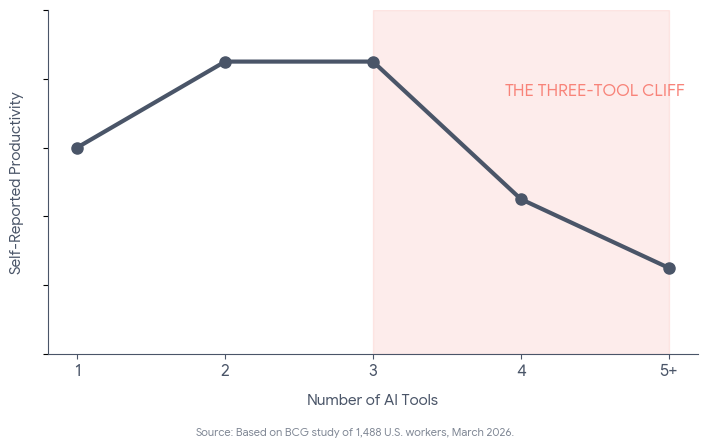
The term comes from a March 2026 study published in Harvard Business Review by researchers at Boston Consulting Group. They surveyed 1,488 full-time U.S. workers and found a clear threshold: productivity climbed when workers used one to three AI tools, then collapsed at four or more.
Workers who crossed that line reported mental fog, difficulty concentrating, and slower decision-making. BCG calls it “AI brain fry” — acute cognitive overload from constant oversight of AI outputs. Among those affected, major errors rose 39% and intent to quit jumped to 34%.
This isn’t an anti-AI argument. The same study found that AI reduces burnout when it handles truly repetitive tasks. The danger is specific: when AI handles the thinking — drafting your strategy, forming your opinions — your brain’s own circuits idle. The chart below illustrates this threshold — BCG’s “three-tool cliff.”
A separate Microsoft and Carnegie Mellon study of 319 knowledge workers confirmed the pattern: the more confident people were in AI’s abilities, the less critical thinking they applied — leaving human judgment weakened exactly when it’s needed most.
Key Takeaway
AI brain fry isn’t burnout — it’s acute cognitive overload. It hits your sharpest, most AI-engaged employees hardest. And it doesn’t build slowly; it strikes in a single afternoon of tool-juggling.
“It was like I had a dozen browser tabs open in my head, all fighting for attention.”
— Senior engineering manager, BCG study participant
What happens to your brain when AI does the thinking?
The mechanism is well-documented outside of AI. When you outsource a cognitive task repeatedly, the neural circuits responsible for it weaken. Neuroscientists call it the “use it or lose it” principle — the same reason heavy GPS reliance correlates with reduced spatial memory.
Cognitive Load Theory distinguishes between extraneous load (formatting, filing, scheduling) and germane load (reasoning, evaluating, connecting). AI is brilliant at eliminating extraneous load. But when it absorbs the germane load — the actual thinking — your prefrontal cortex stops getting the reps that keep it sharp. The diagram below breaks down these two types of cognitive load.
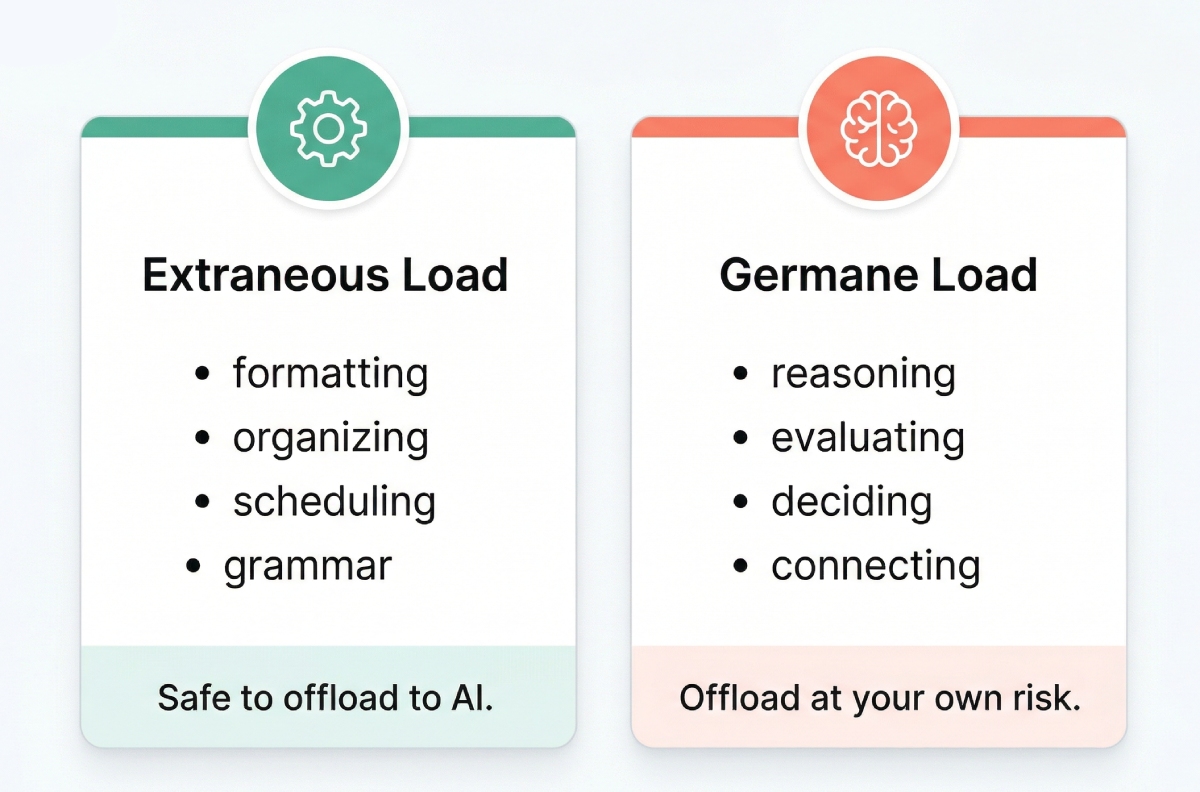
A 2026 report from the University of Technology Sydney describes this as the difference between beneficial and detrimental cognitive offloading. Beneficial: AI handles the grunt work so you can think harder. Detrimental: AI handles the thinking so you don’t have to think at all.
Why does writing your own thoughts activate different brain circuits?
Here’s where the research offers a clear counter-strategy. Writing — specifically, writing your own thoughts in your own words — engages your prefrontal cortex, working memory, and emotional processing simultaneously. It’s one of the few daily activities that forces all three systems to coordinate.
James Pennebaker’s foundational research at the University of Texas demonstrated that writing about personal experiences for 15–20 minutes daily produces measurable cognitive benefits. The mechanism: organizing fragmented thoughts into a coherent narrative — what Pennebaker calls “cognitive integration” — strengthens the exact circuits that passive AI consumption lets atrophy.
A Harvard Business School study tested this in the workplace: employees who spent 15 minutes writing daily reflections performed 22.8% better than colleagues who spent that time continuing to work. Writing didn’t just preserve their thinking — it made them more confident and accurate in applying it.
Fifteen minutes of writing. Twenty-three percent better performance. The ROI of thinking for yourself has never been easier to calculate.
How do you use AI without losing your edge?
The research points to a simple framework: think first, then delegate. Not the other way around.
The 15-minute brain dump. Before opening any AI tool, spend 15 minutes writing what you actually think about the problem. Not polished prose — raw, unstructured thought. What do you know? What’s your gut telling you? What are you unsure about? This forces your prefrontal cortex to do the germane-load processing before AI has a chance to replace it.
Track your emotional state, not just your tasks. One of the subtlest effects of AI overload is losing track of how you feel about your work. Writing reactions (“this project energizes me,” “this decision feels wrong”) keeps your internal compass calibrated when cognitive overload would otherwise drown it out. The workflow illustrated below captures this approach.
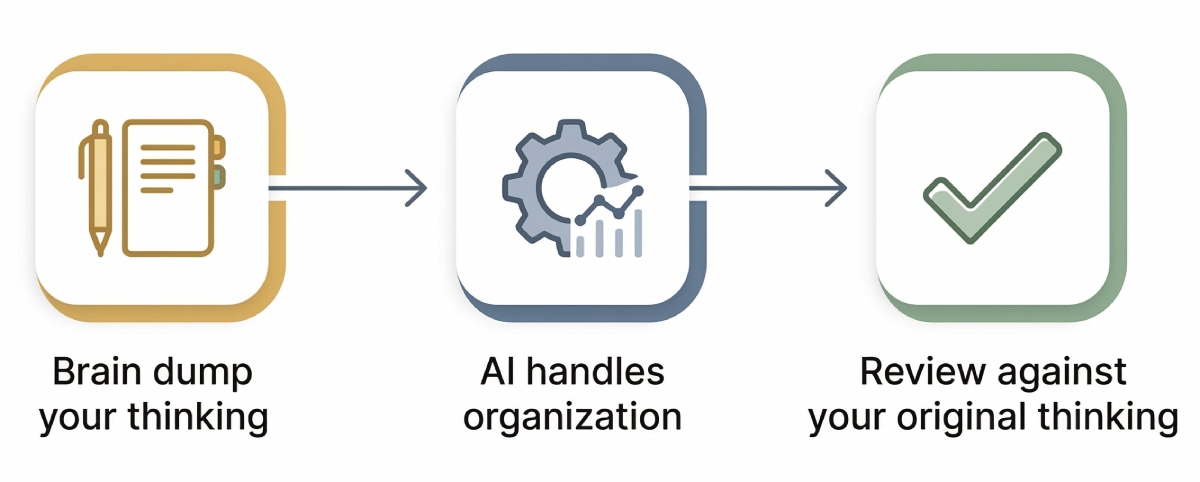
This is exactly what Mindskribe is built for — a personal intelligence platform where you do the thinking and AI handles everything else. You capture a raw thought in seconds — one tap, voice or text, even offline. Mindskribe’s AI then automatically organizes it into a growing knowledge graph, connects it to previous thinking, and surfaces patterns over time. The AI never generates your ideas. It preserves and organizes what you already thought. Your data stays encrypted with AES-256 and is never used to train AI models.
Without a thought-first workflow: you open ChatGPT, ask it to draft your strategy, and your brain shifts into passive evaluation mode. With Mindskribe: you brain-dump your strategy thinking in 90 seconds, and the Knowledge Graph automatically connects today’s insight with the meeting note you captured last Tuesday. Your thinking compounds. The AI keeps it organized.
Key Takeaway
The cognitive defense isn’t “use less AI.” It’s “do your own thinking first, then let AI handle the low-value overhead.” The people who thrive in an AI-saturated workplace won’t be the ones who use the most tools — they’ll be the ones who kept their own thinking sharp while using them.
Who wins the AI era?
The BCG researchers found two distinct patterns. Workers who treated AI as a thinking partner — forming their own views first, then checking AI’s work — got sharper. Those who treated AI as a thinking replacement — accepting outputs uncritically — got shallower.
That 2 PM fog isn’t inevitable. It’s a signal — your brain asking you to do the one thing AI can’t do for you: think your own thoughts first. Start with one today. Write it down before you open a single AI tool.
The Bottom Line
AI brain fry is real, measurable, and already affecting 14% of U.S. workers. But the antidote is remarkably simple: write your own thoughts before outsourcing them. Fifteen minutes of daily reflection rebuilds the exact cognitive circuits that passive AI consumption weakens. The winners of the AI era won’t be the heaviest users — they’ll be the sharpest thinkers.