
TL;DR
Alysa Liu credits journaling with fueling her Olympic gold — and the neuroscience of affect labeling explains exactly why naming your emotions rewires your brain for better performance under pressure.
Seven triple jumps. Zero mistakes. A 20-year-old in a gold dress, grinning at the camera while an arena loses its mind. When Alysa Liu won Olympic gold at the Milano Ice Skating Arena in February 2026, she completed one of figure skating’s most improbable comebacks. Four years earlier, she’d quit entirely — exhausted and struggling. So the obvious question: how?
In a recent interview with Nike, Liu pointed to something surprisingly quiet: “For me, journaling and identifying where that feeling is originating from really helps.”
In Brief
Alysa Liu’s journaling practice works because writing about emotions activates the prefrontal cortex and reduces amygdala reactivity — a process neuroscientists call affect labeling. Research from UCLA and four decades of expressive writing studies show this measurably improves emotional regulation, decision-making, and performance under pressure.
What does naming your emotions actually do to your brain?
Neuroscientists have a term for what Liu described: affect labeling. It’s the act of identifying an emotion in words — not analyzing it, not solving it, just naming it.
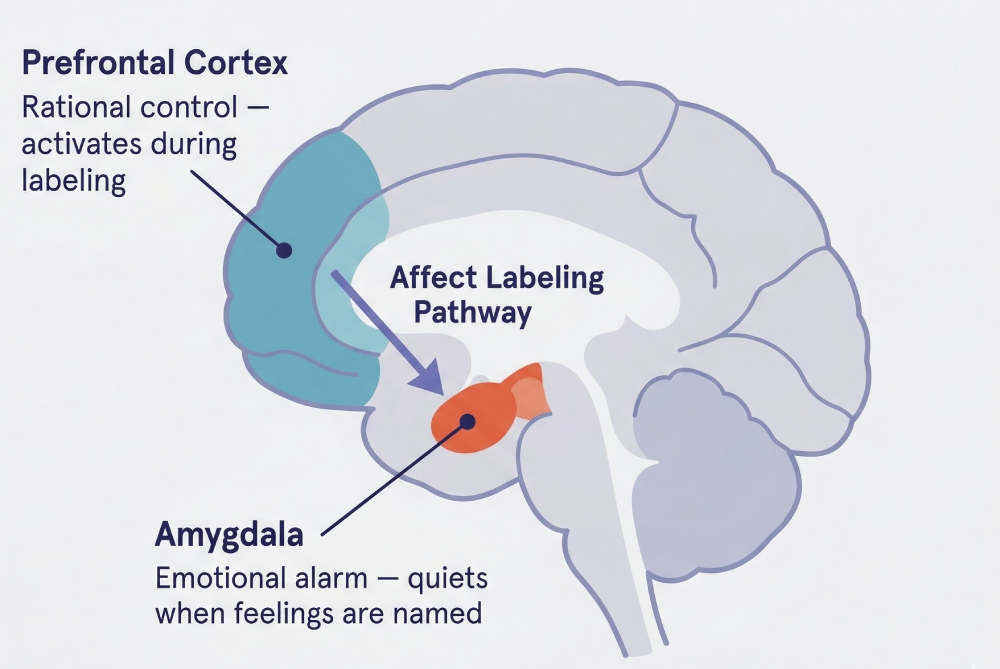
In a landmark 2007 fMRI study, UCLA researcher Matthew Lieberman showed that when people put feelings into words, amygdala activity decreased while the right ventrolateral prefrontal cortex — a region tied to emotional regulation — became more active. Lieberman compared it to hitting a brake pedal: naming a feeling interrupts your brain’s automatic stress response. The diagram below illustrates this pathway.
This builds on James Pennebaker’s foundational expressive writing research spanning four decades, which consistently shows that writing about emotional experiences reduces rumination, improves health markers, and strengthens cognitive function. The mechanism is similar: externalizing internal experience engages higher-order thinking and breaks the cycle of unprocessed emotional weight.
Key Takeaway
Writing the name of an emotion activates your brain’s regulatory systems and quiets its alarm center. This isn’t journaling as self-expression — it’s journaling as cognitive recalibration.
How did self-reflection help Liu come back stronger?
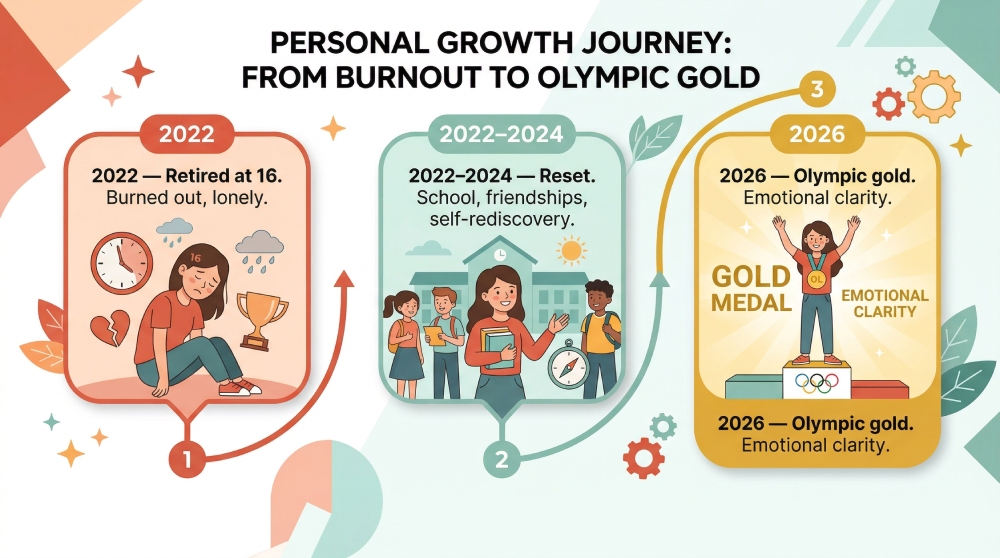
Liu’s backstory makes this detail more meaningful. She became the youngest U.S. women’s national champion at 13. By 16, she’d retired — burned out from relentless training since age five. In a March 2026 interview with Today.com, she put it bluntly: her mental health had been “absolutely horrible.”
What followed wasn’t a recovery plan. Liu focused on school, friendships, family. She got her driver’s license, took her first vacation. She described it as a fundamental reset of her emotional inputs — stepping away from the identity that consumed her childhood.
She didn’t power through the burnout. She stepped back, rebuilt her sense of self, and returned with emotional awareness as her competitive edge.
When Liu returned to competition in 2024, she brought a different relationship to pressure. “Winning and losing don’t affect me anymore... I skate because I like to skate.” That shift — from extrinsic pressure to intrinsic motivation — is exactly what Self-Determination Theory predicts produces sustained high performance. The timeline below illustrates Liu’s emotional arc.
What does “identifying where a feeling is originating from” actually mean?
Liu didn’t say she journals to vent. She said she journals to identify where feelings originate. That’s a specific cognitive move: not just naming the emotion, but tracing it to its source.
In her Nike interview, she described narrowing down pressure — asking who is actually creating the expectation, and discovering that “it’s usually not that many people.” That’s emotional pattern recognition: zooming out from the feeling to its trigger, its context, its origin.
Most people sense their emotional state without ever mapping it. They feel anxious before a presentation, drained by Friday — but the patterns stay invisible. Liu’s practice makes them legible. This is exactly what Mindskribe’s Emotion Insights automates: it analyzes emotional patterns across your captured thoughts using Plutchik’s eight core emotions, then visualizes them through valence meters and heat maps — showing not just what you felt, but when and how often. All data stays AES-256 encrypted and is never used to train AI models.
How do you start tracking your own emotional patterns?
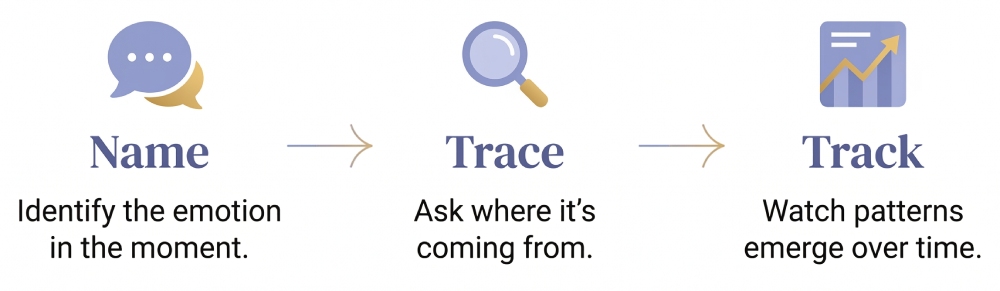
You don’t need an Olympic comeback to apply Liu’s method. Three steps:
1. Name the feeling in the moment. When you notice an emotional shift — tension, irritation, a burst of energy — capture the word. Even a few seconds of labeling activates the prefrontal cortex response Lieberman documented.
2. Ask where it’s coming from. Liu’s key move. Is the pressure from a specific person, a deadline, or your own expectations? Writing the answer forces your brain from reactive to analytical.
3. Look for patterns over time. A single entry is useful. A month of entries is transformative. This is where Mindskribe’s Knowledge Graph becomes powerful — it automatically connects today’s emotional observation with patterns from previous weeks, surfacing links you wouldn’t catch manually. Your data remains private and fully under your control. The visual below illustrates these three steps.
A single journal entry is an observation. A month of entries is an emotional map. Liu built hers by hand. You don’t have to.
The gold medal was a by-product
When Liu finished that free skate in Milan, 200 million viewers saw athletic perfection. What they didn’t see was years of quiet cognitive work — naming feelings, tracing their origins, rebuilding her relationship with pressure from the inside out. The gold medal was a by-product of emotional clarity.
You don’t need to land seven triple jumps. But the inner world Liu learned to navigate — stress, motivation, self-doubt — is the same one running underneath your decisions every day. The question is whether you’re reading it or guessing. Start tracking your emotional patterns with Mindskribe — and build the self-awareness that turns pressure into signal.
Core Insight
Alysa Liu’s journaling practice isn’t a wellness ritual — it’s a performance tool backed by neuroscience. Naming emotions and tracing their origins activates your brain’s regulatory systems and builds compounding self-awareness. The science is clear. The question is whether you’ll start tracking.