TL;DR
The analog trend 2026 is right about the problem — digital overload is frying our brains. But neuroscience shows the fix isn’t abandoning technology. It’s switching from passive consumption to active self-expression, regardless of the medium.
Somewhere right now, a 26-year-old is packing an “analog bag” — crossword puzzles, a film camera, a leather journal — and posting a TikTok about it. The video will get 40,000 views. The comments will say this is the way. And tomorrow, she’ll spend four more hours on her phone.
This is the central contradiction of the analog trend 2026, the biggest lifestyle movement on TikTok this year: a generation shouting “go offline!” through the very screens they’re trying to escape. And while the instinct behind it is sound — UK data shows the average young adult spends six hours and 20 minutes a day on screens, and only 29% feel it helps their mental health — the prescribed solution misses something important.
In Brief
The 2026 “going analog” trend correctly identifies digital burnout as a cognitive crisis. But neuroscience research — including a 2024 Norwegian EEG study published in Frontiers in Psychology — shows that what matters isn’t whether you use paper or a screen. It’s whether you’re passively consuming or actively creating. Writing thoughts on a digital device activates the same brain pathways as pen on paper. The real fix is switching from scrolling to self-expression.
Why is everyone suddenly filling tote bags with puzzle books?
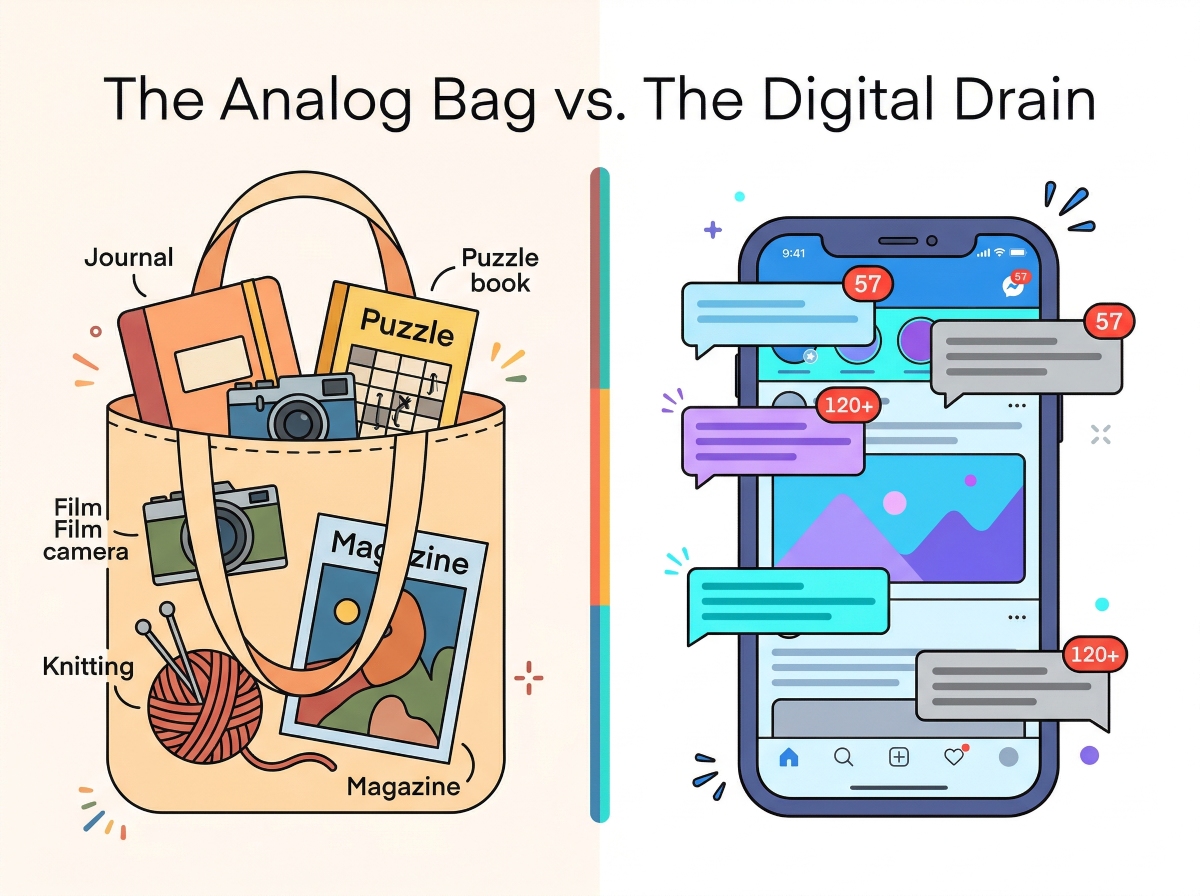
The analog trend isn’t a fringe aesthetic. It’s a mass response to cumulative digital exhaustion. Dazed reports that TikTok creators are recommending swaps like writing in a journal instead of the Notes app, using a digital camera instead of an iPhone, and carrying “analog bags” packed with knitting, magazines, and sketchbooks.
Dr. Kaitlyn Regehr, Associate Professor at UCL and author of Smartphone Nation, frames the movement as a reaction against the attention economy. She compares obsessive screen use to historical health mistakes that future generations will find incomprehensible. The infographic below illustrates the trend.
Content creator Loni, who shares her analog journey on Instagram, captures the sentiment: the movement reflects a desire to slow down, reclaim focus, and engage more meaningfully — not to reject technology entirely, but to stop being consumed by it.
The instinct is real. The data backs it up. But there’s a problem with the prescription.
Does your brain actually care whether you use paper or a screen?
The analog crowd assumes that paper is inherently better for your brain than a screen. The neuroscience is more nuanced.
A 2024 high-density EEG study from the Norwegian University of Science and Technology found that handwriting produced far more widespread brain connectivity than typing on a keyboard — activating regions linked to memory, sensory processing, and motor control that typing barely touched.
The real distinction isn’t paper vs. screen. It’s whether your brain is producing something or just receiving it.
But here’s the part the analog evangelists miss: the study used a digital pen on a screen, not actual paper. Neuroscientist Ramesh Balasubramaniam at UC Merced confirmed to NPR that writing with a stylus activates the same brain pathways as ink on paper. The cognitive benefit comes from the act of forming thoughts into words — the complex motor-sensory loop of creation — not from the material you write on.
A 2025 review in Life (Basel) synthesizing dozens of neuroimaging studies reinforced this: handwriting engages the premotor cortex, parietal regions, cerebellum, and hippocampus in ways that passive keyboard tapping doesn’t. The variable that matters is active production vs. passive input. The brain scan comparison below illustrates this distinction.
Key Takeaway
Your brain doesn’t distinguish between pen-on-paper and stylus-on-glass. It distinguishes between creating (forming your own thoughts into words) and consuming (scrolling, reading, overseeing AI outputs). The analog trend gets the villain right but misidentifies the hero.

What’s actually draining your cognitive battery?
If paper vs. screen isn’t the key variable, what is? The answer: the direction of the information flow.
When you scroll TikTok, read notifications, or oversee AI outputs, information flows into your brain. Your role is passive — evaluate, react, consume. A 2026 BCG study of 1,488 workers found that this kind of digital oversight causes measurable cognitive strain — what researchers called “AI brain fry” — with 14% more mental effort, 12% more fatigue, and 33% more decision errors.
When you write your own thoughts — whether on a napkin or a phone — information flows out of your brain. Your role is active — generate, organize, produce. This is cognitive offloading: the process of externalizing mental content to free up working memory for higher-order processing. The diagram below illustrates these two modes.
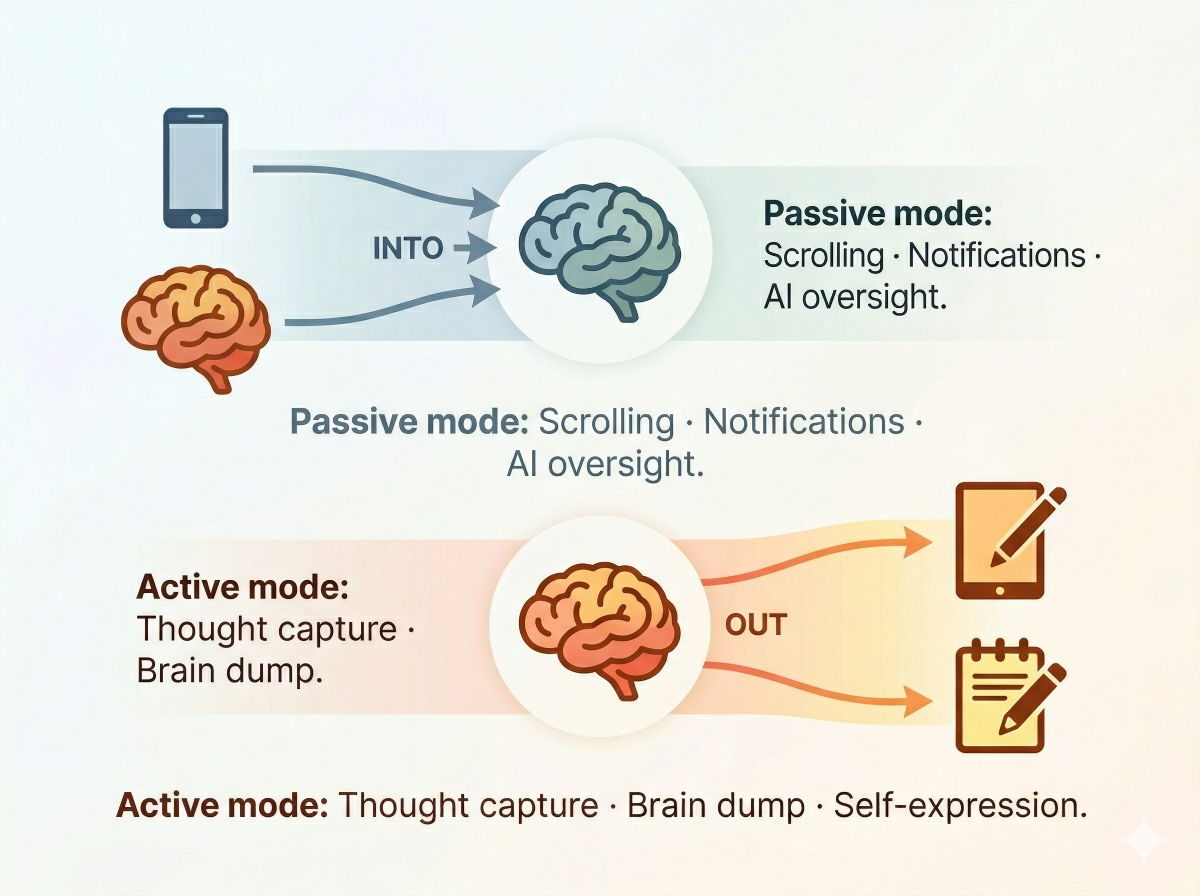
The analog trend throws out the baby with the bathwater. You don’t need to abandon your phone — you need to reverse the direction of the data flow. Stop consuming. Start producing. The medium is secondary.
You don’t need fewer screens. You need fewer inputs and more outputs.
How to capture the cognitive benefits of “going analog” — without going backward
The practical framework is simple: replace passive digital time with active thought capture. Instead of reaching for TikTok when you can’t sleep at 2 AM, dump what’s in your head. Instead of scrolling during your commute, write down the idea that surfaced in the shower. The act of capturing your own thoughts — not consuming others’ — is what rebuilds the neural connectivity the analog trend is chasing.
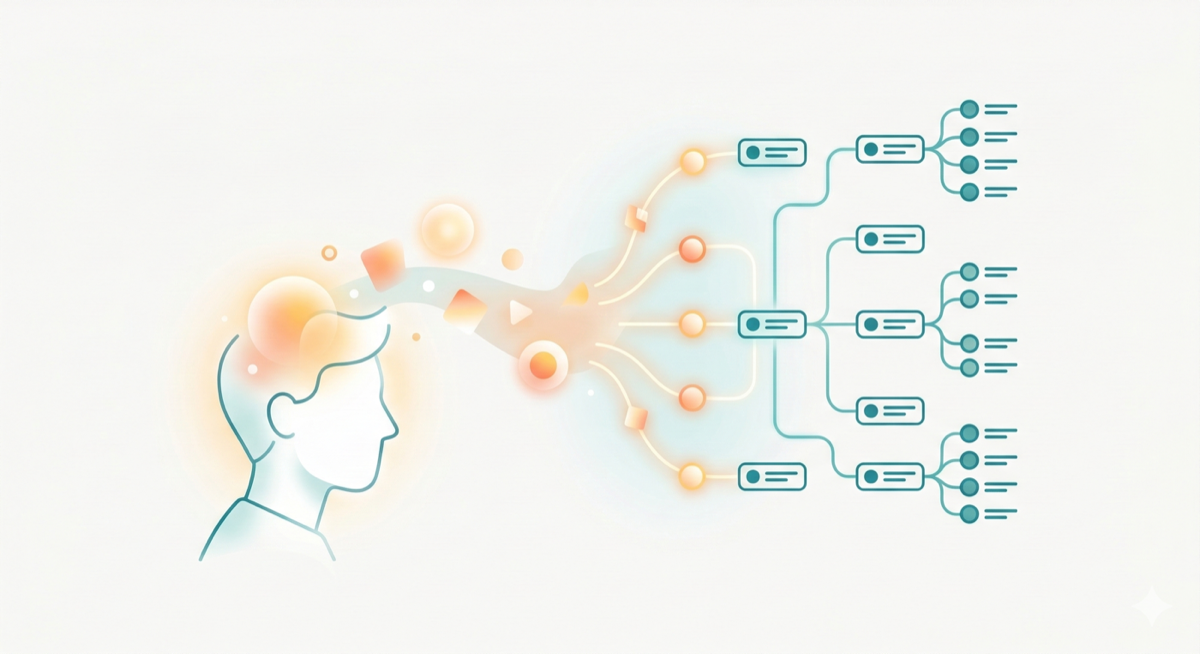
This is exactly what Mindskribe’s one-tap thought capture is built for. You open the app, type or speak what’s on your mind in seconds, and that’s it. No templates. No prompts. No structure required. Your brain does the active work of forming thoughts into words — the part that fires up those premotor cortex and hippocampal circuits. Then Mindskribe’s Knowledge Graph automatically organizes your scattered thoughts into connected patterns, and Aura AI can surface past insights when you need them — with tappable citations back to your original thoughts so you can verify every connection. All of this happens behind the scenes, encrypted with AES-256 and never used to train AI models. Your thinking stays yours.
Without this kind of tool, the analog approach has a structural flaw: that brilliant 2 AM thought goes into a paper journal that you’ll never search, never cross-reference, and probably never reread. With Mindskribe, the thought gets the cognitive benefits of active capture AND the organizational power of AI — without demanding any of the oversight that causes brain fry. The comparison below illustrates the difference.

The analog trend is a signal, not a solution
Remember our TikToker with the analog bag? Her instinct was right. The fatigue is real, the science confirms it, and doing something about it matters. But the answer isn’t to rewind to 1997. It’s to stop using technology on your brain and start using it for your brain.
Your cognitive battery doesn’t drain because you picked up a screen. It drains because the screen picked up you. Reverse the flow — capture what’s in your head, not what’s in your feed — and the brain does exactly what TikTok’s analog crowd is searching for. It reconnects. It quiets down. It starts working for you again.
Start capturing your thoughts with Mindskribe — and keep your analog bag for the crosswords.
The Bottom Line
Digital burnout is real, but going fully analog isn’t the fix. Neuroscience shows your brain benefits from active self-expression, not from any specific material. The most powerful thing you can do is switch from consuming content to capturing your own thoughts — on whatever device is in your hand.