TL;DR
Eileen Gu credits journaling for reshaping her brain. Neuroscience confirms it: writing your thoughts activates prefrontal circuits that passive consumption bypasses. The practice is available to everyone.
At the 2026 Winter Olympics in Milano Cortina, a reporter asked Eileen Gu a simple question: "Do you think before you speak?" What followed wasn't a sound bite — it was a masterclass in neuroscience that went viral within hours, racking up millions of views and igniting a global conversation about how we think, and whether we can change it.
"You can control what you think," the 22-year-old Olympic champion explained. "You can control how you think, and therefore you can control who you are." She then named the mechanism behind her confidence: neuroplasticity — the brain's ability to physically reshape itself based on what you repeatedly do, think, and pay attention to.
But here's the part most headlines missed. Gu didn't credit visualization or meditation or some expensive biohacking protocol. She credited something far simpler: "I journal a lot. I break down all of my thought processes. I apply a very analytical lens to my own thinking, and I modify it."
In other words, the most decorated freestyle skier in Olympic history reshapes her brain by capturing her thoughts — and then examining them like a scientist.
Eileen Gu explains how she uses journaling and neuroplasticity to reshape her thinking.
What Is Neuroplasticity, and Why Should You Care?
For most of the 20th century, scientists believed the adult brain was essentially fixed — that after childhood development, your neural architecture was set in stone. We now know that's wrong. Research over the past three decades has demonstrated that the brain continuously reorganizes itself by forming new neural connections throughout life. Every thought you return to, every emotional pattern you rehearse, every behavior you repeat strengthens a specific neural pathway.
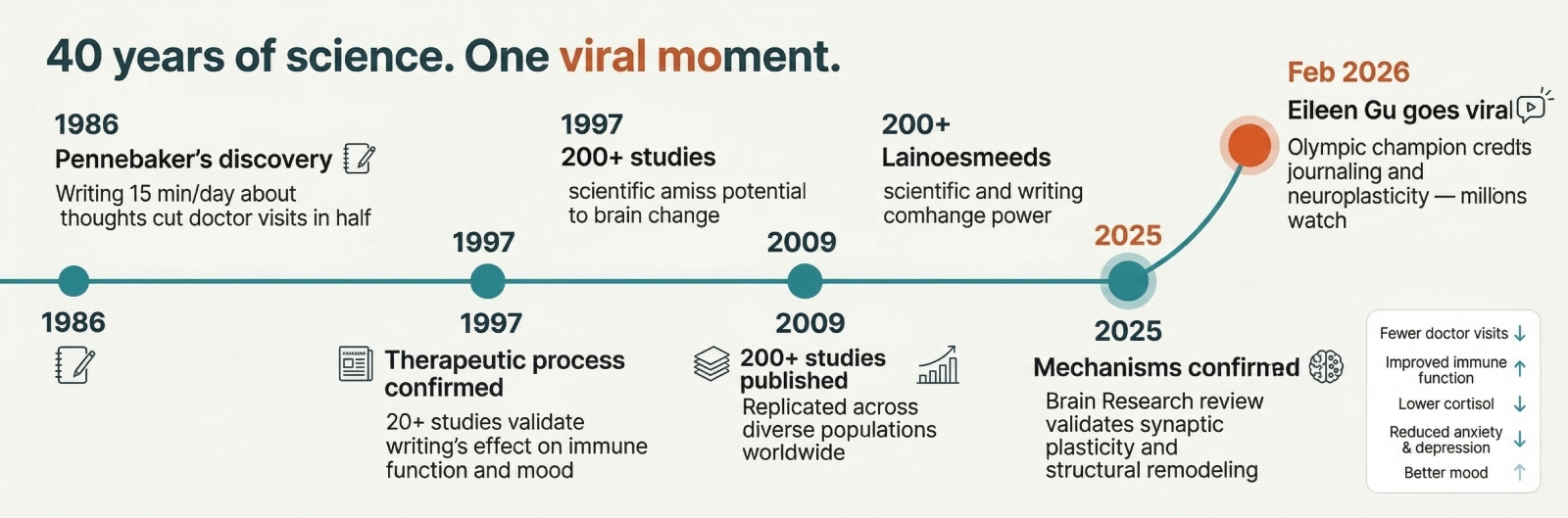
This isn't metaphor. According to a comprehensive 2025 review in Brain Research, neuroplasticity encompasses synaptic plasticity (how connections between neurons strengthen or weaken), structural remodeling (physical changes in brain tissue), and functional reorganization (how the brain reassigns tasks across regions). These mechanisms operate across your entire lifespan.
The implications are profound. As Psychology Today puts it: the importance of neuroplasticity can't be overstated, because it means changing dysfunctional patterns of thinking and behavior is not only possible — it's how the brain is designed to work.
Key Takeaway
Your brain isn't a fixed machine. It's a living system that physically reshapes itself based on what you repeatedly think, feel, and do. Neuroplasticity means you're always becoming — the question is whether you're directing the process or letting it run on autopilot.
Why Journaling Is the Ultimate Neuroplasticity Hack
If neuroplasticity is the brain's capacity to change, journaling is one of the most powerful tools to direct that change intentionally. And the science backs this up at every level.
It Offloads Mental Clutter
Your working memory holds roughly four to seven items at once. When unfinished tasks, unresolved worries, and half-formed ideas pile up, your brain loops through them compulsively — a phenomenon psychologists call the Zeigarnik effect. Writing a thought down performs what researchers call cognitive offloading: it frees your brain's limited RAM for higher-order thinking like analysis, creativity, and problem-solving. (We explored this mechanism in depth in our post on the science behind writing down your thoughts.)
It Activates Prefrontal Processing
When you write about your thoughts — especially with the analytical lens Gu describes — you engage the prefrontal cortex, the brain's executive control center. This region is responsible for planning, decision-making, and emotional regulation. By translating vague mental noise into concrete words, you shift activity from the reactive amygdala (your brain's alarm system) to the reflective prefrontal cortex. Over time, this strengthens the neural pathways for deliberate, measured thinking.
It Creates New Neural Pathways Through Repetition
Neuroplasticity follows a simple rule: neurons that fire together wire together. When you journal consistently — capturing a thought, examining it, and choosing how to respond to it — you're rehearsing a specific cognitive pattern. Over weeks and months, that pattern becomes automatic. What once required conscious effort becomes your brain's default mode of operation.
It Regulates Emotion at a Biological Level
James Pennebaker's landmark research on expressive writing demonstrated that writing about thoughts and feelings for just 15–20 minutes a day produces measurable biological changes: improved immune function, lower cortisol, reduced blood pressure, and fewer symptoms of anxiety and depression. Multiple meta-analyses across hundreds of studies have replicated these findings. The mechanism is neuroplastic: repeated emotional processing through writing literally reshapes the brain's stress response circuitry.
Key Takeaway
Journaling doesn't just help you feel better in the moment. It physically reshapes your brain's stress response, strengthens prefrontal executive function, and builds new neural pathways for clearer thinking — all through the simple act of capturing and examining your thoughts.
The Eileen Gu Method: Thinking Like a Scientist About Your Own Mind
What makes Gu's approach so powerful — and so applicable beyond elite sports — is her framing. She doesn't journal to vent. She doesn't write morning pages for creative inspiration. She approaches her own thinking the way she approaches freestyle skiing: "I'm always trying to modify. How can I be better? How can I approach my own brain the way that I approach my craft?"
This is a fundamentally different relationship with your own thoughts. Most people experience thinking as something that happens to them — a stream of consciousness they're swept along by. Gu treats thinking as something she does — a skill she can observe, analyze, and improve. As emotional intelligence author Justin Bariso noted in Inc., this is exactly the trait that distinguishes the most successful performers across sports and business.
Here's how that translates into a practice anyone can adopt:
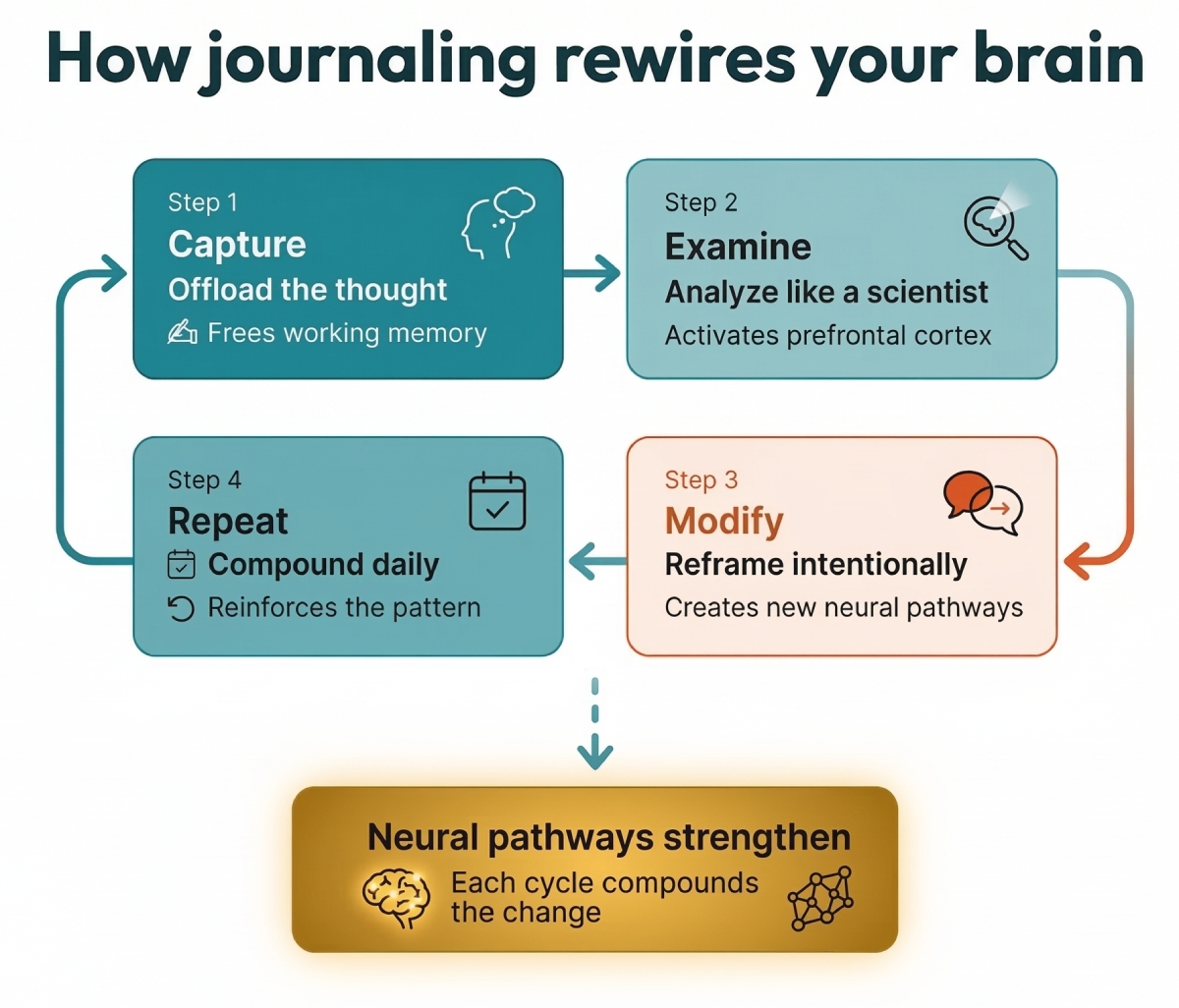
- Capture the raw thought — Write down exactly what you're thinking, without editing or judging. This is the cognitive offloading step: get it out of your head and onto a page (or a screen).
- Apply an analytical lens — Look at the thought as data, not truth. Is this a pattern? Is this fear-based or evidence-based? What assumptions am I making?
- Modify intentionally — Choose how you want to think about this topic going forward. Not through forced positivity, but through deliberate reframing grounded in what you've observed.
- Repeat consistently — Neuroplasticity requires repetition. A single journaling session won't change your brain. Daily practice — even five minutes — compounds over weeks into genuine cognitive transformation.
Arianna Huffington, who publicly endorsed Gu's approach, put it succinctly: the small choices we repeat every day can strengthen our neural circuits and make certain behaviors more automatic.
Beyond Mindset: Why Experience Matters Too
It's worth noting — because intellectual honesty matters — that some neuroscientists have pushed back on the simplest reading of Gu's viral moment. Dr. Tawny Kross, writing on Medium, argued that neuroplasticity isn't only about thinking differently. Patterns also change through what she calls corrective experience — small, repeated experiences that give your nervous system new data contradicting old predictions. Memory reconsolidation research supports this: when you retrieve an old memory and pair it with a new, non-threatening experience, the original memory gets updated.
But here's the crucial point: this nuance actually strengthens the case for thought capture rather than weakening it. When you journal about a stressful situation and then consciously process it in a safe environment, you're providing exactly the kind of corrective experience the nervous system needs. You're not just thinking about the thought — you're creating a new embodied experience of engaging with it calmly and analytically, rather than reactively. The act of writing is both a cognitive exercise and a nervous system intervention. Mindset and bodyset, working together.
How This Connects to Everyday Life (Not Just Olympic Gold)
You might be thinking: Sure, neuroplasticity works for a 22-year-old Stanford student with world-class coaching and elite genetics. But the research doesn't support the idea that brain change is only for the gifted few. Neuroplasticity is a universal human capacity. What varies is whether people intentionally leverage it.
Consider how Gu's practice maps to ordinary scenarios:
- Career decisions — Instead of ruminating endlessly about whether to take a new role, capture the pros and cons as distinct thoughts over days or weeks. Let patterns emerge across your entries, and make a decision grounded in your own accumulated thinking rather than a single anxious evening.
- Emotional regulation — Instead of spiraling at 2 AM, offload the worry in a quick capture. The act of writing it down breaks the loop. Over time, you train your brain that these thoughts don't need to keep cycling.
- Self-understanding — Track your emotional state alongside your thoughts over weeks and months. Patterns emerge that you'd never notice in real time: what triggers your stress, what sparks your creativity, how your mood shifts across different projects or relationships.
- Learning and growth — Capture insights from books, conversations, and experiences. When you revisit and connect them later, you build a personal knowledge base that compounds — exactly the way neuroplastic learning works.
"I get to become every day the kind of person that me at age eight would revere."
— Eileen Gu, 2026 Winter Olympics press conference
From Brain Science to Daily Practice
The gap between knowing about neuroplasticity and actually using it comes down to one thing: consistency. The brain changes through repetition, not revelation. You don't need a perfect journaling habit. You need a captured thought — honest, unfiltered, quick — repeated daily. Over time, the act of observing your own thinking changes the thinking itself.
This is what tools like Mindskribe are built for. Not as a journal in the traditional sense, but as a system for capturing thoughts effortlessly throughout your day — in the shower, on your commute, at 2 AM — and then letting AI surface the patterns, connections, and emotional trends you'd never notice on your own. It's the analytical lens Gu describes, made accessible to everyone.
When Gu says she approaches her brain "like a scientist," she's describing a practice of externalized self-reflection: get the thought out of your head, examine it from the outside, and decide what to do with it. That's neuroplasticity in action. And unlike Olympic-level skiing, it doesn't require world-class talent — just the willingness to start capturing what's on your mind.
Key Takeaway
Eileen Gu's viral neuroplasticity moment wasn't about having a special brain. It was about having a specific practice — journaling, analyzing, and intentionally modifying her thought patterns. That practice is available to everyone. The neuroscience says so. The question is: what will you capture first?
This article was written by the Mindskribe Team. Mindskribe is an AI-powered thought capture app referenced in this post. Read more about the science of thought capture, or get started for free.